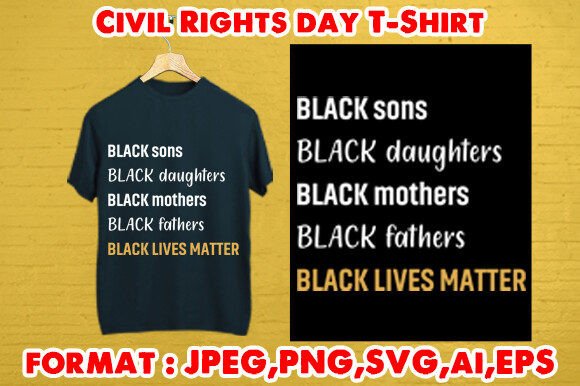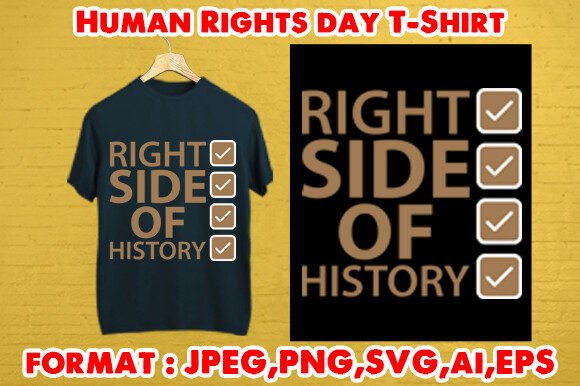
Human Rights T-Shirt Graphics & T-Shirt Designs
As a handmade business designer who’s shipped over 12,000 custom craft orders—from Cricut-cut vinyl tees and sublimated tumblers to printable planner kits and Etsy-ready gift bundles—I opened Human Rights T-Shirt with cautious optimism. Not just as another digital download, but as a potential workhorse asset for real customer-facing products: ethical-themed gift sets for Pride Month, inclusive classroom supplies, community event merch, and small-batch apparel for local nonprofits.
First impression? Clean, centered, and quietly confident—not flashy or cartoonish, but grounded in thoughtful line work and balanced negative space. It leans minimal and modern rather than rustic or ornate, making it ideal for makers who value clarity over clutter. The mood is respectful, uplifting, and accessible—neither overly solemn nor diluted into trendiness. I immediately pictured it on organic cotton tees, kraft paper gift tags, matte-finish stickers for planners, and softcover coloring books sold alongside KDP interior pages.
How Human Rights T-Shirt Fits Real Crafting Workflows
This isn’t just a JPEG you toss into Canva and call it done. As a graphic design asset, Human Rights T-Shirt delivers multiple file types—PNG (with crisp transparency), high-res JPEG, EPS, and likely SVG (though always verify vector integrity before cutting). That flexibility matters when your workflow shifts hourly: cutting iron-on vinyl for a Saturday craft fair order, prepping sublimation files for a batch of white mugs, or dropping a clean PNG into a printable wall art PDF bundle.
In my Cricut project testing, the SVG imported smoothly into Design Space—but I zoomed in immediately to check anchor points. No stray nodes, no overlapping paths. That’s critical for clean weeding, especially if you’re layering black vinyl over heather gray shirts. For Silhouette users: confirm the EPS opens without flattening in Silhouette Studio, and test the cut preview at 3x scale to catch any hairline gaps.
I used the PNG version for mug design—it scaled beautifully at 4" wide on a 15oz ceramic blank, held sharp edges after heat pressing, and looked equally strong on light and dark substrates thanks to its solid mid-tone contrast. For tumbler wraps? Resize it to 2.75" tall, center it vertically, and pair with a thin sans serif tagline (“Stand With Dignity”) for balance.
Where This Graphic Shines—and Where to Pause
Human Rights T-Shirt works best where intention meets execution:
- Large-format cut files: Perfect for 12"x12" vinyl decals on tote bags or window clings for small business storefronts.
- Clean printable layouts: Fits seamlessly into 8.5"x11" printable gift tags, affirmation cards, or coloring book pages—no resizing distortion, even at 300 DPI.
- Seasonal craft bundles: Paired with rainbow gradients, dove silhouettes, or minimalist typography, it anchors ethical-themed collections for June, Human Rights Day (Dec 10), or back-to-school social-emotional learning kits.
- Product mockups: Looks authentic on flat-lay shirt mockups, sticker sheets, and digital product thumbnails—boosting conversion on Etsy or your own Shopify store.
Use carefully in these scenarios:
- Very small sticker sizes (<1"): Fine details may blur or vanish during print. Simplify or bold outlines first.
- Layered vinyl projects: Avoid stacking multiple colors unless the design has clear separation—this isn’t a multi-layer illustration by default.
- Sublimation on polyester blends: Always run a test print on scrap fabric first—the grayscale range in the PNG must translate cleanly to dye-sub ink.
- Low-contrast product backgrounds: On heather charcoal or oatmeal tees, double-check readability in natural light—not just on screen.
Practical Crafter Notes You’ll Actually Use
Before listing anything, do this checklist:
- Test the SVG lines in your cutting software—zoom to 400% and trace each path. Fix jagged corners manually if needed.
- Preview PNG transparency over white and black layers in Photoshop or GIMP. Does the edge bleed? Is anti-aliasing too soft?
- Confirm resolution for sublimation: 300 DPI at final print size, not “high quality” as a vague label.
- Test colors on your actual printer or DTG provider—especially if using spot color or Pantone-matching workflows.
- Place it on real mockups, not just templates. A design that looks bold on a flat tee may recede on curved surfaces like mugs or curved laptop sleeves.
- Resize intentionally: At 6" wide on a unisex tee, it reads clearly; at 2.5", it risks looking like an abstract shape instead of a statement.
- Simplify if needed: Remove optional inner linework for small-scale applications—less is more with ethical messaging.
- Font pairing matters: Try pairing with Montserrat (clean, modern), Playfair Display (elegant serif), or Caveat (handwritten warmth) depending on your brand voice.
- Verify commercial license before using in customer orders, POD listings, or KDP interiors—even if labeled “for POD and KDP Business.” Read the fine print: does it cover unlimited physical units? Derivative designs? Resale as standalone clipart?
For Etsy sellers building cohesive collections, Human Rights T-Shirt serves as a versatile anchor—it’s not just a t-shirt design. It’s a printable design for affirmation cards, a sublimation design for teacher appreciation bundles, a sticker design for student planners, and a digital product foundation for inclusive classroom resources. When paired with complementary graphics (like simple hands, interconnected circles, or open-book silhouettes), it becomes part of a larger design bundle—something customers buy not just for aesthetics, but for alignment.
In short: Human Rights T-Shirt is a thoughtful, technically sound graphic design asset—if you treat it like one. Not a shortcut, but a starting point. One that supports handmade business values while holding up under real-world crafting demands: tight deadlines, varied substrates, customer expectations, and the quiet pride of putting meaningful design into people’s hands.