PATRONES CUBISTAS TRADICIONALES
First Impressions: Bold, Structured, and Surprisingly Warm
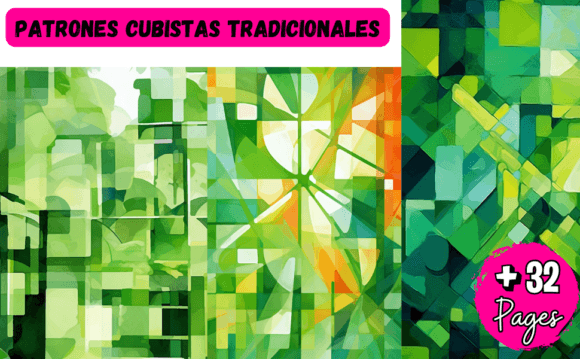
Opening PATRONES CUBISTAS TRADICIONALES, I felt that familiar designer spark—the kind you get when a visual language clicks before you even thread a needle. This isn’t chaotic abstraction; it’s intentional geometry with soul. Think flattened faces, interlocking planes, stylized florals and folk motifs reimagined through a cubist lens—but grounded in tradition, not avant-garde theory. The 32-page full-color digital package reads like a curated sketchbook: clean lines, confident negative space, and rhythmic repetition that translates beautifully to stitch. It’s the kind of Illustrations set that makes you immediately picture it on a linen tea towel or stitched onto a heavyweight cotton tote—not as decoration, but as identity.
A Real-World Test: Embroidering a Boutique Baby Blanket
Last week, I used one of the medium-scale motifs from PATRONES CUBISTAS TRADICIONALES for a custom baby blanket order—soft organic cotton, light gray base, satin-stitched floral-cubist medallion centered on the corner. What stood out wasn’t just how sharp the angles held up (they did), but how the design *breathed* on fabric. Unlike overly dense machine embroidery designs that flatten texture, these patterns leave room for the cloth—and for the hand-feel customers pay for in handmade products. Parents commented on how “artful but not fussy”—a rare win for baby embroidery, where simplicity and durability are non-negotiable. That balance is core to what makes PATRONES CUBISTAS TRADICIONALES work beyond the screen.
Where It Shines (and Where It Asks for Thought)
PATRONES CUBISTAS TRADICIONALES excels in projects where clarity, character, and quiet sophistication matter:
- Custom apparel: Sweatshirt embroidery gains instant personality without overwhelming the garment—ideal for small shop merchandise or Etsy seller branding.
- Embroidered patch applications: Clean edges and strong silhouettes hold up beautifully in cut-and-sew or iron-on formats.
- Holiday embroidery and personalized gifts: A cubist star or simplified nativity motif reads clearly at 3–4 inches—no fuzzy detail loss, even after washing.
- Printable mockups and digital product previews: Because the files are high-res and color-balanced, they render authentically across KDP interiors, POD platforms, and social media thumbnails.
But—and this matters—it’s not universally plug-and-play. On thin or stretchy fabric, tight corners and intersecting lines can pucker if stabilizer choice isn’t dialed in. On dark fabric, fine interior linework may vanish unless thread colors are deliberately contrasted. And while many motifs scale well, the most intricate ones (think multi-layered geometric birds or nested mandalas) demand careful review before committing to a curved surface like a cap or a pillow cover seam.
Design Integrity Meets Commercial Reality
As someone who evaluates hundreds of Graphics packs a year for client work and my own craft business, I look beyond aesthetics to how a design affects perception. PATRONES CUBISTAS TRADICIONALES elevates perceived value—not by being flashy, but by feeling *considered*. Customers notice when an embroidered tote bag doesn’t look like generic clip art. They trust brands that use cohesive, intelligent design assets. That subtle shift—from “nice” to “made with intention”—directly impacts buyer engagement, repeat orders, and word-of-mouth referrals. For Etsy sellers or boutique owners, this isn’t just a pattern pack; it’s part of your visual voice.
Practical Embroidery Designer Notes (From My Hoop to Yours)
Before stitching your first project with PATRONES CUBISTAS TRADICIONALES, here’s what I do—and recommend:
- Test on scrap fabric first, especially if using textured weaves (like burlap tea towels) or lightweight knits.
- Check thread color contrast in both natural and artificial light—cubist shading relies on tonal shifts, not gradients.
- Review stitch density manually: Some motifs use clever fill stitch rhythms that minimize bulk while maximizing impact—perfect for baby embroidery or wearable items.
- Confirm hoop size compatibility: While the PDFs are print-ready, verify digital file dimensions match your machine’s maximum hoop area before digitizing.
- Inspect small details at 200% zoom—especially eyes, stems, or connecting lines—then test them in black-and-white mockups to ensure legibility.
- Compare light vs. dark fabric backgrounds: What reads crisply on ivory may disappear on charcoal unless you adjust underlay or thread weight.
- Use proper stabilizer: Medium-weight cutaway works best for structured motifs; tear-away suffices for looser, open compositions.
- Confirm licensing: Since PATRONES CUBISTAS TRADICIONALES is marketed for KDP Interior, POD, and book cover design, double-check terms before selling finished embroidered goods or reselling digital files.
Final Thought: Design That Supports Your Craft, Not Just Fills Space
PATRONES CUBISTAS TRADICIONALES doesn’t shout. It invites closer looking. It rewards thoughtful execution—whether you’re stitching a single holiday embroidery gift or building a full line of small shop product. It’s the kind of embroidery file that makes your process feel more like curation than production. And in a market flooded with overdesigned, low-intent graphics, that distinction is everything. Use it where boldness meets restraint—and where every stitch feels like part of a larger, quieter story.