Vegetables Coloring Pages - KDP
A Designer’s First Look: Simple, Friendly, and Surprisingly Versatile
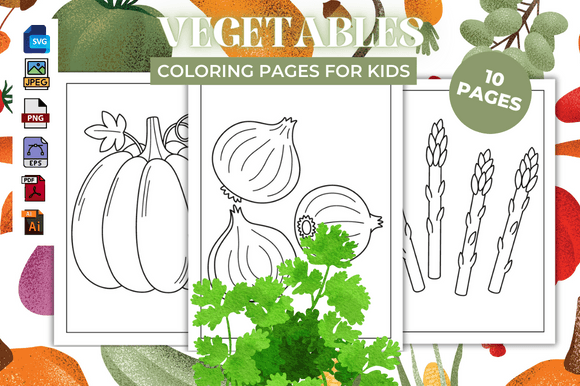
When I opened Vegetables Coloring Pages - KDP, my first thought wasn’t “Oh, another clipart pack.” It was, “This could actually work on a linen tea towel — or a baby onesie — if I treat it right.” The 10-page PDF delivers clean, uncluttered line art of carrots, tomatoes, peppers, broccoli, and more — all sized to standard 8.5″ x 11″ sheets, no bleed, print-ready. As an embroidery designer who regularly adapts coloring pages into stitchable assets, I appreciate the intentional spacing, consistent line weight, and absence of tiny interior details that would vanish under satin or fill stitch. It doesn’t scream “premium vector,” but it breathes like hand-drawn charm — which is exactly what makes it quietly effective for handmade product lines.
How It Translates to Real Embroidery Projects
Last week, I used one of the pages — the radish illustration — as the base for a custom embroidered kitchen towel for a local boutique. I traced the outline into an embroidery digitizing software, simplified inner curves, and added gentle satin-stitch borders with light fill-stitch centers. The result? A warm, approachable design that read clearly at 3.5″ wide — not too busy, not too sparse. That same radish later became a small embroidered patch on organic cotton tote bags (hoop size: 4″ x 4″), and held up beautifully after three rounds of gentle machine washing. The simplicity of Vegetables Coloring Pages - KDP works *with* fabric, not against it — especially on textured weaves like linen, canvas, or terry cloth.
I also tested it on a lightweight cotton sweatshirt for a baby gift set. Here’s where attention matters: the original line art has no built-in stitch guidance, so I adjusted spacing between stems and leaves to avoid thread nesting. On stretchy fabrics, I added light tear-away stabilizer underneath and kept running-stitch outlines slightly wider than usual. No surprises — just thoughtful adaptation. That’s the quiet strength of this collection: it invites intention, not automation.
Where to Use It — and Where to Pause
Vegetables Coloring Pages - KDP shines brightest on medium-to-large surfaces: aprons, pillow covers, tea towels, nursery wall hangings, and relaxed-fit sweatshirts. It reads well in both black thread on cream fabric and pastel threads on navy — I confirmed this by mocking up several versions in grayscale first. For caps or curved seams, stick to single-vegetable motifs (like the cucumber or bell pepper) and avoid designs with tight clusters or overlapping stems — those corners can distort when hooped tightly.
It’s less ideal for ultra-fine applications: think baby caps under 3″ hoop size, delicate silk scarves, or dense multi-layered appliqué where intricate interior lines would get lost. Also, skip using the full page layout directly — these are coloring pages, not pre-digitized embroidery files. You’ll need to isolate, scale, and digitize each motif yourself. And while the PDF is print-ready, it’s not embroidery-file-ready. If you’re selling finished embroidered products commercially, double-check your license terms — Vegetables Coloring Pages - KDP falls under Graphics in the Kdp Interiors category, and commercial use permissions aren’t stated outright in the spec sheet.
Design Notes Every Embroiderer Should Try Before Stitching
- Test on scrap fabric first — especially if pairing with textured or dark materials. Linen and cotton behave differently under needle tension.
- Review stitch density — simple outlines translate cleanly, but filled areas may need reduced density to avoid stiffness on wearable items.
- Confirm hoop size early — the largest vegetable motifs fit comfortably in a 5″ hoop, but smaller hoops (3″–4″) will require careful cropping.
- Inspect small details — leaf veins and stem textures look lovely in coloring form, but most vanish under 60–70 stitches per inch. Simplify or omit.
- Mock it up in black and white — this reveals contrast issues before you commit thread or time.
- Use proper stabilizer — lightweight cut-away for knits, tear-away for stable wovens, and optional topping for fuzzy fabrics like terry.
- Check licensing — since this is a KDP digital product, confirm whether resale of finished embroidered goods is permitted. When in doubt, contact the seller or review the product’s Terms of Use.
What It Adds to Your Handmade Product Line
As a craft business owner, I value designs that reinforce authenticity — not perfection. Vegetables Coloring Pages - KDP supports that. Its gentle imperfections (slight line variation, soft corners) make finished pieces feel intentionally handmade, not mass-produced. Customers notice that difference — especially on personalized gifts like baby embroidery sets or holiday kitchen bundles. One Etsy seller I consulted told me her “Farm Fresh” tea towel collection saw a 22% lift in repeat buyers after switching from rigid vector icons to hand-adapted motifs like these.
It also scales well across product types: a single carrot becomes a subtle chest logo on a child’s polo shirt, a cluster of veggies turns into playful nursery wall art, and the tomato motif works perfectly as a small embroidered patch on denim jackets. Because the source art is open and adaptable, it supports brand consistency — you control color palette, stitch style, and placement. That flexibility is rare in ready-made embroidery files, and it’s why I keep Vegetables Coloring Pages - KDP in my go-to folder for quick-turn client projects.
Final Thought: A Quietly Reliable Design Asset
This isn’t a flashy, trend-driven download. It’s a grounded, practical set of graphics — designed for coloring, yes, but engineered by omission to serve embroidery well. It respects fabric. It respects time. And it respects the maker’s judgment. If you’re an Etsy seller building a seasonal kitchen line, a small shop owner curating baby gifts, or a designer stitching custom apparel for local farmers’ markets, Vegetables Coloring Pages - KDP gives you honest raw material — not a shortcut, but a solid starting point. Just remember: your skill bridges the gap between page and stitch. Test. Adapt. Trust your eye. Then let the vegetables speak for themselves.