Word Tracing Worksheets Coloring Pages Graphics
As a digital product creator who’s launched over 200 printable bundles across Etsy, Creative Market, and Shopify—mostly for educators, parents, and craft-based small businesses—I recently tested Word Tracing Worksheets Coloring Pages as a potential core asset for a back-to-school KDP interior + printable bundle. Here’s my honest, shop-floor-level review—not hype, just what works, what doesn’t, and where this set earns its place in your design library.
First Impression: Playful, Purpose-Driven Line Art
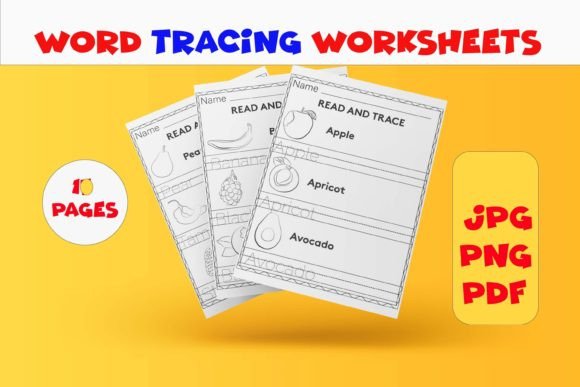
The moment I opened the ZIP file, I noticed clean vector-style line art on every page—no shading, no gradients, just confident, consistent strokes. The mood is warm and approachable: not overly cutesy or cartoonish, but gently expressive—think rounded letterforms paired with simple botanicals, animals, and everyday objects (apple, sun, cat, boat) that match each traced word. It leans into the “educational-but-joyful” niche without sacrificing visual cohesion. This isn’t decorative clipart—it’s functional illustration designed to support early literacy. That makes it ideal for sellers targeting preschool teachers, homeschoolers, and occupational therapists—not just general coloring-page buyers.
Where It Shines in Real Product Creation
Word Tracing Worksheets Coloring Pages isn’t just a PDF download—it’s a flexible graphic design asset that scales across multiple commercial formats:
- SVG & PNG products: Each page converts cleanly to SVG with smooth paths—great for Cricut projects like custom tracing boards, laminated learning mats, or classroom flashcards.
- Printable design bundles: Use individual pages as standalone printable design assets—add them to themed collections like “Back-to-School Learning Kits” or “Fine Motor Skill Printables.”
- Sublimation design and mug design: Isolate single illustrations (e.g., the “sun” tracing page) and pair with minimalist typography for kids’ drinkware on print-on-demand platforms.
- Canva template integration: Drop pages into editable Canva layouts—combine with editable text boxes for customizable lesson plans or parent handouts.
- Tote bag prints, tumbler wraps, and nursery prints: The clean line work holds up well at larger sizes, especially when grouped with coordinating borders or subtle watercolor textures.
- Social media graphics and blog visuals: Use cropped sections (e.g., just the “cat” outline + “C-A-T”) for Instagram carousels explaining phonics strategies.
Boosting Product Presentation—Without Extra Work
This set quietly elevates your Etsy product or digital download listing. Because each page features strong visual hierarchy—clear tracing lines + supportive illustration—it performs exceptionally well in mockups. I dropped one page into a framed printable wall art mockup and immediately saw higher perceived value versus generic coloring sheets. Thumbnails pop on dark backgrounds too, thanks to generous white space and bold outlines. For seasonal bundles (e.g., “Summer Learning Pack”), pairing two or three pages with matching fonts creates instant brand consistency—even without a logo.
Best Use Cases for Maximum ROI
Use Word Tracing Worksheets Coloring Pages where clarity and intent matter most:
- Large-format printable products (8.5" x 11", A4, or tabloid)
- Themed design bundles (e.g., “Alphabet Tracing + Nature Illustrations”)
- Decorative layouts in Canva templates or digital planners
- Product mockups for Etsy or Creative Fabrica listings
- Creative marketplace submissions where educational credibility matters
Where to Proceed With Caution
Not every use case fits seamlessly. Avoid using these pages for:
- Tiny sticker designs: Fine interior details (like tiny leaves inside letters) may not cut cleanly at under 1" tall on Cricut or Silhouette machines.
- Overly dense layouts: The charm lies in breathing room—don’t cram four pages into one PDF thumbnail.
- Low-resolution print products: While the source files are crisp, avoid scaling beyond 200% without verifying line integrity.
- Dark-background merch without testing contrast first—the line weight is medium, not heavy, so preview on black mugs or navy tote mockups.
- Text-heavy templates: These aren’t display fonts—they’re tracing guides. Pair them with legible sans serif or clean script fonts, never compete with them.
Practical Seller Notes Before You List
Before adding Word Tracing Worksheets Coloring Pages to your next design bundle, do these five quick checks:
- Test on real mockups: Drop one page into a printable wall art and a tumbler wrap mockup—see how spacing and scale feel in context.
- Preview as a thumbnail: Zoom out to 25%—does the central illustration still read clearly?
- Check background contrast: View on both white and charcoal backgrounds. Adjust stroke weight if needed (lighten or darken via vector editor).
- Verify PNG transparency: Ensure no stray pixels or anti-aliasing halos around edges—critical for sticker and sublimation use.
- Confirm commercial license terms: This is a commercial design asset—but double-check whether redistribution or derivative rights apply before bundling into Canva templates or physical kits.
Also: organize files thoughtfully for customers—label by word (“apple-tracing”, “boat-tracing”), include both PDF and individual PNG/SVG exports, and suggest compatible fonts (I paired mine with Quicksand for headings and KG Primary Dots for traceable letters—both widely available and classroom-friendly).
In short, Word Tracing Worksheets Coloring Pages is a focused, execution-ready graphic design asset—not flashy, but deeply functional. It supports small business branding through consistency, strengthens handmade business credibility with pedagogical intent, and quietly lifts the professionalism of any creative marketplace listing. If your shop serves learners, makers, or mindful parents, this set earns its spot—not as filler, but as foundation.