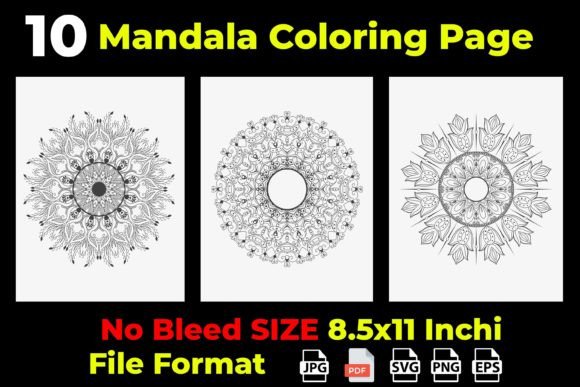
Ornament Floral Mandala Coloring Pages
A Designer’s First Glance: Vintage Charm, Not Just Lines
When I opened Ornament Floral Mandala Coloring Pages, I didn’t see “just another coloring book.” I saw a quiet, confident visual language—vintage ornament shapes wrapped in retro floral swirls and balanced mandala symmetry. It’s monochrome, yes, but not flat. There’s rhythm in the line weight, breathing room between elements, and a deliberate softness in the curves that hints at hand-drawn warmth—not digital rigidity. As an embroidery designer who regularly translates 2D graphics into stitched texture, this matters deeply. This isn’t background filler. It’s a ready-made motif with built-in hierarchy: a central focal ornament, layered florals, and swirling borders that naturally guide the eye—and the needle.
What It Becomes When Stitched: A Tote Bag That Feels Intentional
Last week, I test-embroidered one of these pages onto a natural linen tote for a local boutique launch. Not as a full-page print—but scaled to 4.5 inches wide, centered on the front panel, using a satin stitch outline + light fill stitch for the inner petals. The result? A refined, heirloom-adjacent piece customers paused to touch. Why? Because the original Ornament Floral Mandala Coloring Pages design carries inherent balance: no single element overwhelms; negative space is generous; and the swirls translate beautifully into flowing satin-stitch curves. It reads clearly even at medium distance—critical for apparel or home goods where legibility affects perceived value. On a sweatshirt? It holds up. On a tea towel? It adds quiet sophistication without competing with function.
Where It Shines (and Where It Needs Care)
This set works exceptionally well for:
- Embroidered patches — clean outlines and moderate detail mean crisp edges without excessive thread build-up
- Baby items and nursery decor — the gentle vintage mood reads as soothing, not fussy, and avoids overstimulating complexity
- Holiday gifts and wedding favors — think embroidered pillow covers or linen napkins; the ornament shape nods to tradition without cliché
- Small shop merchandise — especially for boutiques leaning into slow craft, botanical aesthetics, or mindful branding
- Personalized gifts — pair one motif with a monogrammed corner or subtle date stamp for emotional resonance
But be thoughtful with placement and execution:
- Avoid dense fill stitches on thin or stretchy fabric — the swirls invite detail, but overloading them on jersey or lightweight cotton can cause puckering. Opt for running stitch outlines or open-fill patterns instead.
- Test on dark fabric first — while the monochrome source is neutral, thread contrast changes everything. A cream satin stitch on charcoal linen reads elegantly; the same on black velvet may disappear without metallic or high-sheen thread.
- Respect curved surfaces — caps and baby bonnets distort fine swirls. Simplify outer loops or reduce scale by 15–20% before digitizing.
- Don’t force it into tiny hoops — some motifs include delicate inner flourishes best preserved above 3" diameter. Below that, prioritize clarity over completeness.
How It Elevates Your Craft Business—Beyond the Stitch
As an Etsy seller and small shop owner myself, I judge design assets not just by prettiness—but by how they affect buyer trust, perceived professionalism, and repeat engagement. Ornament Floral Mandala Coloring Pages supports all three. Its cohesive vintage-retro voice helps unify a product line—imagine matching embroidered aprons, kitchen towels, and gift tags, all anchored by variations of the same motif. Customers recognize consistency. They feel the care behind curation. And because the designs are monochrome and graphic-first, they adapt seamlessly across mediums: printed mockups, laser-cut wood ornaments, or even hand-painted ceramics alongside your stitched pieces.
For commercial embroidery projects, this set offers reliable scalability. No awkwardly stretched lettering or pixelated edges—just intentional line work that digitizes cleanly. That means less time troubleshooting stitch density, fewer client revisions, and more confidence when quoting custom apparel or boutique orders.
Practical Notes Every Embroidery Designer Should Run Through
Before turning Ornament Floral Mandala Coloring Pages into a finished product—whether for sale or gifting—do these six things:
- Test on scrap fabric that matches your final substrate (linen, cotton twill, fleece) and note stabilizer behavior—lightweight cutaway often wins here.
- Check thread color contrast in both natural and artificial light. What reads softly in daylight may vanish under store lighting.
- Review stitch density in tight swirl areas—dense fills trap moisture and stiffen fabric, especially on baby items or wearables.
- Confirm hoop size compatibility with your machine and intended product. Don’t assume a 5x7" design fits neatly on a curved cap front.
- Inspect small details at actual stitch scale—those inner floral dots may need simplification for 30–40 weight thread.
- Verify licensing for commercial use. Since this is listed as a KDP interior, confirm whether resale of finished embroidered goods or derivative digital products is permitted.
Final Thought: A Quiet Design That Carries Weight
Ornament Floral Mandala Coloring Pages doesn’t shout. It settles. And in today’s handmade market—where buyers scroll past noise to find authenticity—that’s its real strength. It’s not a trend-chasing graphic. It’s a timeless anchor: flexible enough for a modern embroidered patch, grounded enough for a holiday heirloom pillow, and detailed enough to reward close looking—without demanding perfection from your machine or your hands. Use it thoughtfully, scale it intentionally, and let its quiet confidence do the talking. That’s how good design serves both maker and customer—not as decoration, but as intention made visible.